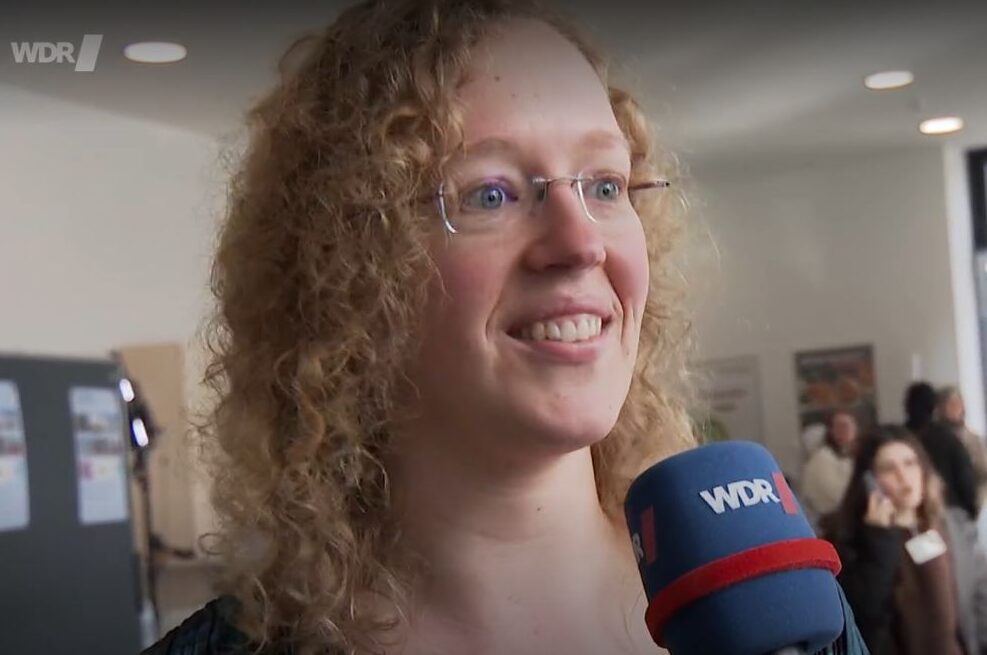
How does scientific curiosity arise? And what does it take to turn interest into an academic career? Answers to these questions were provided by the 25th Schnupper Uni at the University of Bonn. Around 225 female students in grades 10 to 13 took advantage of the opportunity to experience research firsthand for a day – in a practical, interactive way and in direct exchange with scientists.
The Schnupper Uni is part of the University of Bonn’s strategic promotion of young talent. The aim is to give young women an early insight into STEM degree programs, create opportunities, and break down barriers. The event was co-organized by Dr. Felix Jonathan Boes (Institute of Computer Science IV), Equal Opportunities Officer of the Department of Computer Science and affiliated with the Lamarr Institute. Together, the Department of Computer Science at the University of Bonn and the Lamarr Institute actively promote gender equality and diversity in STEM. In mathematics and science subjects in particular, the visibility of role models often determines whether an interest in studying is actually pursued.
Scientific excellence meets outreach: Impulse from Prof. Dr. Lena Funcke
Lena Funcke, Clausius Professor in the Transdisciplinary Research Area Matter at the University of Bonn and Associated Principal Investigator at the Lamarr Institute for Machine Learning and Artificial Intelligence, set a central tone. In her opening speech, she spoke about her own path into theoretical physics, about interdisciplinary research between quantum field theory and data-driven methods – and about the importance of access and encouragement.
Funcke described how scientific career paths are rarely straightforward, but are always characterized by curiosity, perseverance, and inspiring encounters. Formats such as the taster university could provide decisive impetus: “Access creates ambition.”
Bringing research to life – specifically strengthening the next generation
In workshops on computer science, mathematics, and natural sciences, participants experienced research as an active process: programming, experimenting, developing models, and discussing results. This is precisely where sustainable talent promotion comes in. Formats such as the taster university combine scientific excellence with targeted outreach work and strengthen self-efficacy and study orientation in equal measure.
For the Lamarr Institute, this commitment is an expression of a broader understanding of research: excellent science has an impact when it becomes visible, creates access, and involves the next generation of STEM talent at an early stage.