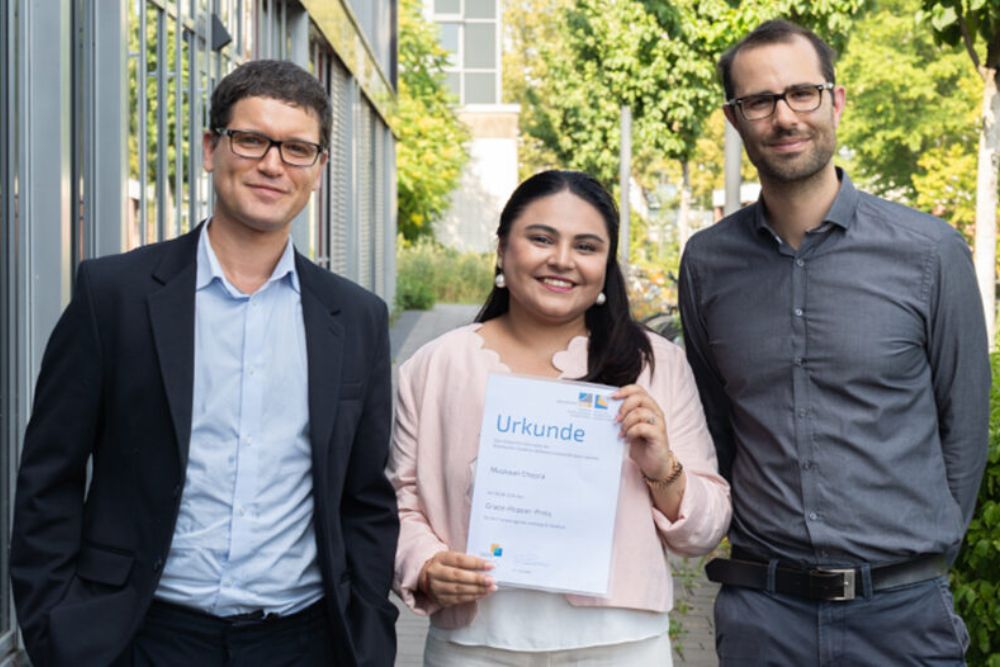
Muskaan Chopra is among this year’s recipients of the Grace Hopper Award presented by the Institute of Computer Science at the University of Bonn. The award ceremony took place on June 26, 2026, as part of the institute’s annual summer event. In her master’s thesis, Chopra investigated how compact AI models can detect critical errors in machine translations. Conducted in the Hybrid Machine Learning Lab under the supervision of Prof. Dr. Rafet Sifa and Dr. Lorenz Sparrenberg, the work is closely linked to research at the Lamarr Institute.
Small language models can detect translation errors that sound natural
Automatic translations can sound fluent and convincing yet still alter the meaning of the source text. For example, even a single incorrectly translated negation can turn a medical recommendation or a set of technical instruction into the exact opposite. Chopra investigated whether small, locally deployable language models can reliably identify such critical errors. She examined, among other factors, how model size, adaption strategies, and quantization affect their performance. Quantization involves storing numerical values within an AI model with lower precision. This reduces memory requirements and computational demand, although it can also affect the model’s performance. The research therefore brings together questions of reliability and the resource-efficient use of AI. Chopra ist the first author two publications on critical errors in machine translation that were published in collaboration with the Lamarr Institute at the international conferences IEEE BigData 2025 and ECIR 2026. Chopra will continue her research as a doctoral student.
Early-Career Researchers Study Reliable AI in Real-World Conditions
The Grace Hopper Award is presented annually to female students by the Institute of Computer Science and the Bonn Computer Science Society. The award recognizes outstanding student research and substantial contributions to scientific publications. Named after the American computer science pioneer Grace Hopper, the award aims make the scientific achievements of female students more visible and encourage them to pursue new directions in research.
This year’s other Grace Hopper Award recipients included Carla Münnich and Yasmin Schmiede. Schmiede’s award-winning master’s thesis examines how mobile robots can find target objects in changing environments or when the objects are partially hidden from view. Leif van Holland received the Best Poster Award, and a special prize recognized six bachelor’s and master’s theses supervised by Prof. Dr. Matthew Smith in connection with the DARPA Artificial Intelligence Cyber Challenge. In these projects, the students investigated, among other things, how language models and other AI methods can be used to automatically detect and analyze software vulnerabilities. Taken together, the award-winning projects approach a central question in Lamarr research from different perspectives: How can learning systems be designed to operate reliably with limited resources, in dynamic environments, and in applications where errors can have serious consequences?