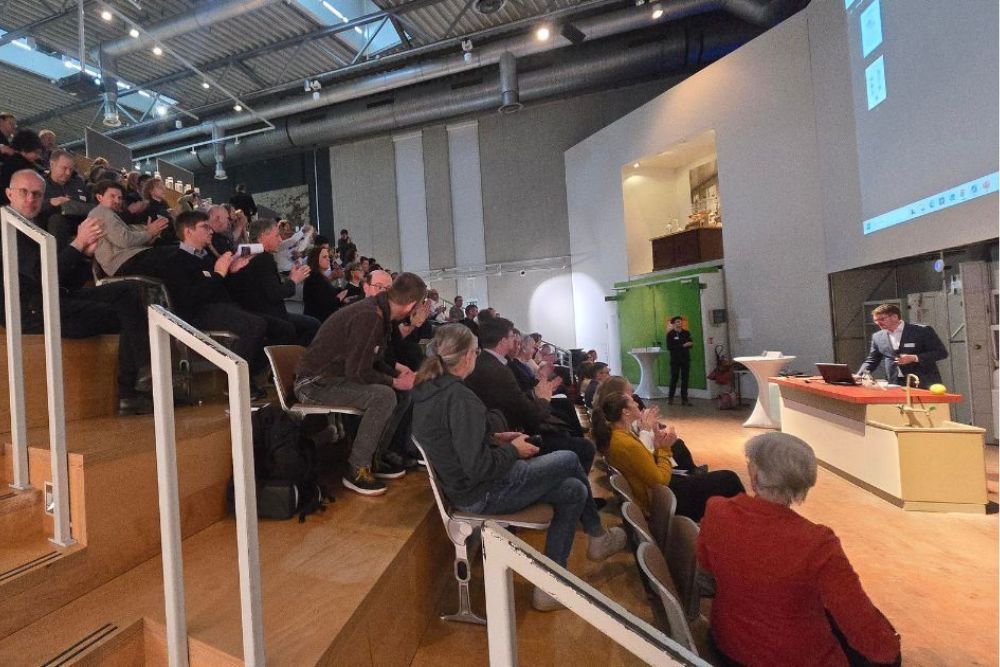
How exactly can artificial intelligence improve the world of work? How can research findings be translated into practice more quickly? These questions were the focus of the second AI Workshop, which took place on March 17, 2026, in Dortmund. Around 100 participants from academia and industry came together to discuss current developments and examine specific use cases. The event demonstrated that the need for exchange is growing as the pressure to develop viable solutions for everyday work.
The workshop was organized by the Federal Institute for Occupational Safety and Health (BAuA) and took place at the DASA Arbeitswelt exhibition. In addition to the BAuA, the co-organizers included the Lamarr Institute for Machine Learning and Artificial Intelligence, the Technical University of Dortmund, and the Research Center for Trustworthy Data Science and Security (RC-Trust). The venue itself set the tone: the path through historic industrial backdrops led directly into discussions about the future of work. The content focused primarily on practical issues, such as the use of intelligent assistance systems or the design of secure and trustworthy AI applications.
From Technology to Human-Centered Applications
In interactive sessions, participants discussed specific challenges from their day-to-day work. Researchers from the Lamarr Institute for Machine Learning and Artificial Intelligence shared their perspectives: Prof. Dr. Matthias Feurer is working on automated learning methods that facilitate the use of AI in business processes, while Prof. Dr. Jens Teubner is investigating how data-driven systems can be efficiently integrated into real-world application contexts. At the same time, it became clear that the key lever lies less in the isolated use of new technologies and more in organizations’ willingness to holistically rethink work processes and consistently design them using digital solutions. This involves not introducing applications in isolation, but rather developing, testing, and refining them in alignment with real-world workflows. From the perspective of work research, it remains crucial to embed technological innovations in a way that enhances employee safety, health, and acceptance.
The AI Workshop is thus part of a broader trend: As AI becomes increasingly widespread in companies, the question of how to design work in a way that is humane is coming to the forefront. Institutions such as the Lamarr Institute for Machine Learning and Artificial Intelligence and the Technical University of Dortmund are actively driving this integration of cutting-edge research and practical application. The Dortmund event serves as an example of how this transfer can succeed and why it is crucial for the future of the workplace.