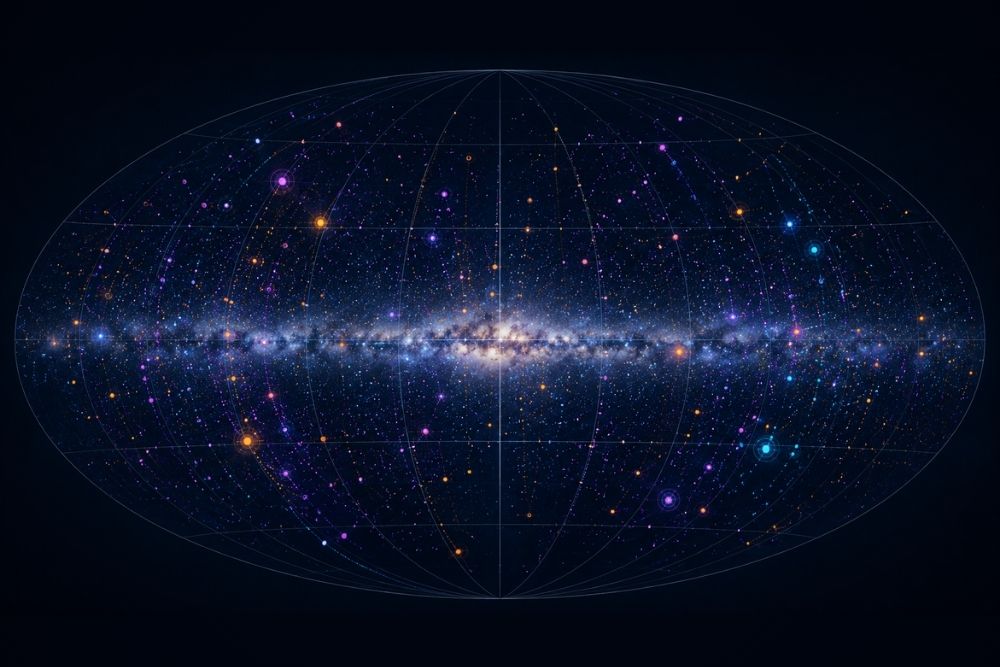
The German Research Foundation (DFG) has approved funding for Collaborative Research Center (CRC) 1491, “Cosmic Interacting Matter – From Source to Signal,” for another four years. The research consortium, led by astroparticle physicist Prof. Dr. Julia Tjus, investigates some of the highest-energy processes in the universe. The second funding phase begins in July 2026. Tjus is also an Associated Principal Investigator at the Lamarr Institute for Machine Learning and Artificial Intelligence.
Tracing the Univers’ Most Energetic Processes
The Collaborative Research Center investigates how high-energy particles, radiation, and magnetic fields interact with one another in the cosmos. The focus is on questions that have occupied astrophysicists for decades: Where do cosmic particles with extreme energies originate? How do they propagate through the universe? And what role does dark matter play in these phenomena?
To get to the bottom of these phenomena, the researchers are combining observational data from various sources. This so-called multi-messenger approach integrates information from sources such as gamma-ray and cosmic-ray data, neutrino detectors, and astronomical observations. Only by combining these signals can researchers build a more complete picture of the underlying physical processes.
Using AI to Turn Signals into Models of the Universe
The extension of funding is intended, in particular, to further strengthen the connection between theoretical models, particle physics, and observational data. This generates large and complex datasets, the analysis of which requires increasingly powerful computational methods. Machine learning methods, for example, help identify patterns in measurement data, model astrophysical processes, or evaluate simulations more efficiently.
The Collaborative Research Center operates at the intersection of astroparticle physics, data-intensive modelling, and artificial intelligence. In this way, the Collaborative Research Center addresses questions that are also significant for the development of modern AI methods.
Significance Beyond Astrophysics
Modern telescopes and detectors now generate volumes of data that would have been unimaginable just a few years ago. The challenge lies not only in collecting this information, but also in meaningfully linking it together and analyzing it scientifically. Advances in astrophysics are therefore increasingly emerging from the interplay of specialized science, data analysis, and artificial intelligence.
The extension of funding for Collaborative Research Center 1491 underscores the scientific importance of this work and highlights how data-driven approaches are helping researchers investigate fundamental questions about the origin and evolution of the universe.