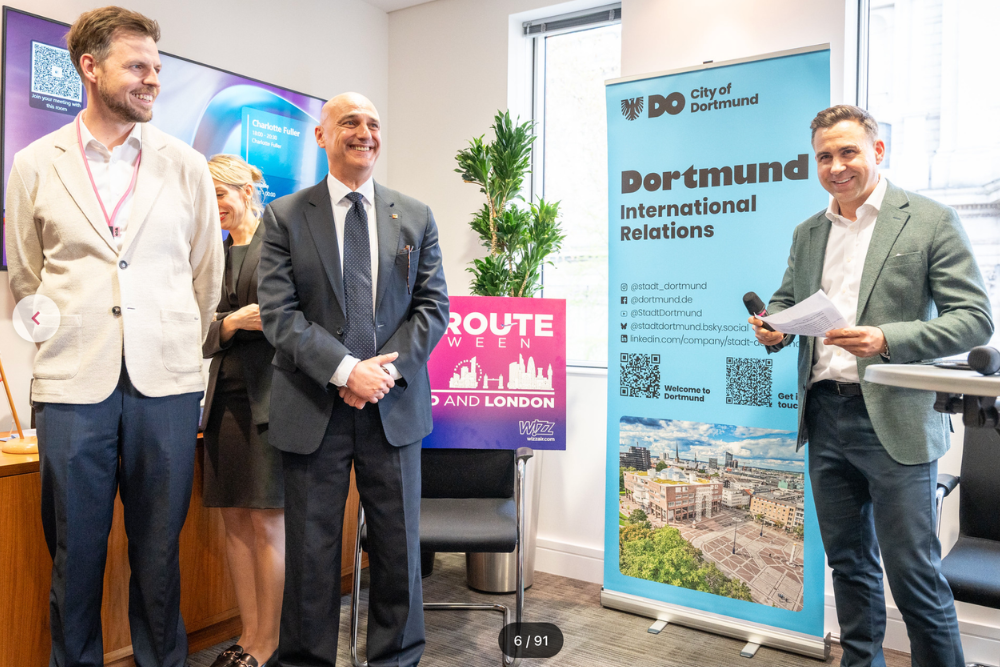
How quickly AI innovations can be translated into practical applications increasingly depends on the structure of entire ecosystems. A delegation trip from the city of Dortmund to London, led by Mayor Alexander Kalouti and organized in collaboration with the Dortmund Economic Development Agency, provided insights into one of Europe’s most dynamic AI hubs. Stops along the way included the AI company Instadeep, the startup Synthesia, and a meeting at the business development agency London & Partners—a platform for international networking and startups—where several young companies presented their AI-based business ideas. Prof. Dr. Sebastian Peitz from the Lamarr Institute for Machine Learning and Artificial Intelligence was part of the delegation; he particularly emphasized the close integration of startups, research, and industry as a defining factor.
Quick implementation thanks to close integration
In London, research-intensive universities intersect with an active startup scene and globally active technology companies. New developments are often translated into market-ready applications at an early stage, not least because exchange and collaboration between these stakeholders are structurally embedded. Discussions with companies, startups, and networks such as the German Business Hub London also highlighted the central role of personal connections in building sustainable partnerships. “In addition to a very active AI startup scene, London also boasts strong industrial research. This combination creates an environment in which innovation is put into practice particularly quickly,” said Peitz.
Spin-offs as a bridge between research and application
Against this backdrop, spin-offs from academia are increasingly coming into focus as a unifying element. They can translate research findings into concrete applications at an early stage while simultaneously feeding new ideas back into research. In ecosystems such as London, this creates dynamic feedback loops between academic work, entrepreneurial development, and industrial application.
For North Rhine-Westphalia as an AI hub, this means that existing scientific strength provides a solid foundation for systematically expanding transfer mechanisms, whether through international collaborations, closer networking with industrial partners, or greater visibility for entrepreneurial initiatives emerging from the research community.