Digital Twin Medicine – When AI Needs to Understand Cause and Effect
Why an artificial intelligence system can make the wrong decision despite having access to thousands of patient records – and how researchers are working to change that.
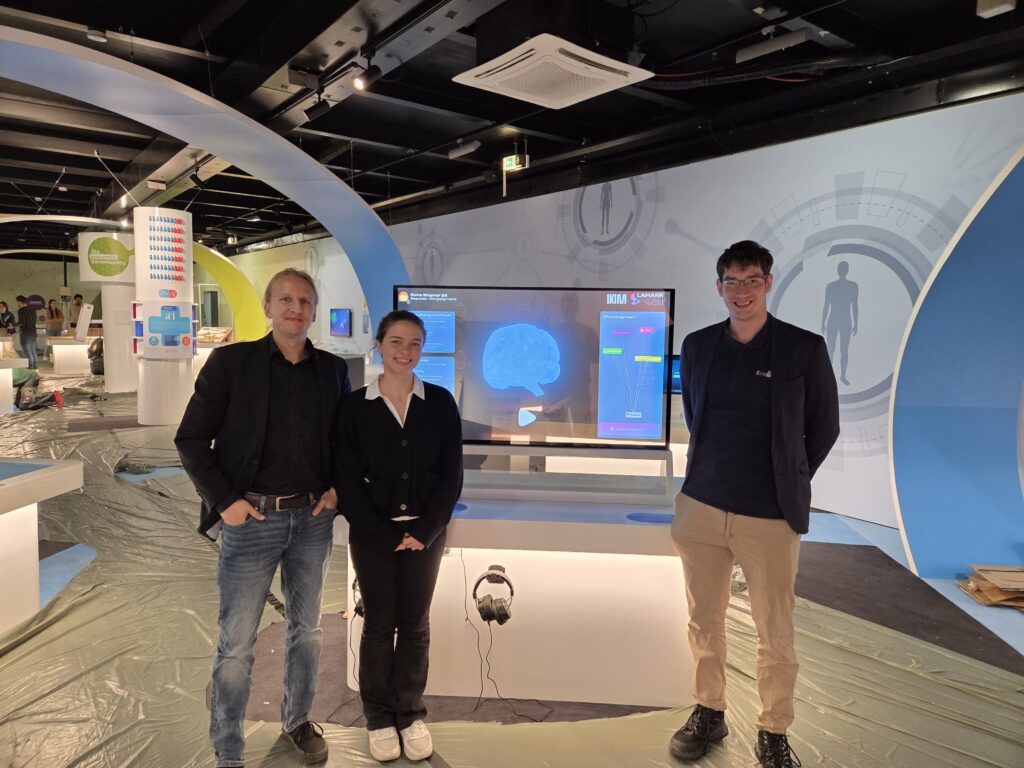
You Have Just Challenged an AI
In the exhibit, you met Elena, a 34-year-old patient diagnosed with a brain tumor. Your task was to help an artificial intelligence system determine the best treatment for her.
Along the way, you may have noticed something surprising: although the AI had learned from thousands of previous patient cases, it initially made the wrong recommendation.
The problem wasn’t a lack of data. On the contrary – the AI had plenty of information.
What it lacked was an understanding of why certain relationships existed.
That question lies at the heart of our research.
Why Did the AI Get It Wrong?
Artificial intelligence is exceptionally good at detecting patterns. For example, it may learn that patients who received steroids often experienced poorer outcomes.
A conventional AI might therefore conclude:
Steroids are harmful.
But that conclusion is incorrect.
The real explanation is that steroids were primarily prescribed to the sickest patients. The treatment did not cause the poor outcome; rather, the severity of the illness influenced both the treatment choice and the patient’s prognosis.
This illustrates the crucial difference between correlation and causation.
Why More Data Is Not Necessarily Better
A common assumption is that giving an AI more data will automatically improve its decisions.
Surprisingly, that is not always true.
If the underlying relationships remain misunderstood, a conventional AI simply learns the same statistical patterns – and may become even more confident in an incorrect recommendation.
This is why researchers are developing AI systems that can move beyond recognizing patterns to understanding cause-and-effect relationships.
What Is Causal AI?
Causal AI extends traditional machine learning by incorporating models that explicitly represent cause-and-effect relationships.
Instead of asking:
“Which patients had similar outcomes?”
a causal model asks:
“What would happen if we changed the treatment?”
This brings AI closer to the way physicians reason in clinical practice. Rather than relying solely on patterns in historical data, they consider biological mechanisms, medical knowledge, and the likely consequences of different treatment decisions.
What Is a Digital Twin?
A Digital Twin is a virtual representation of a real-world system – in this case, a patient.
Researchers can use such models to simulate different treatment options before they are applied in clinical practice, helping them better understand which therapy may be most suitable for an individual.
Digital Twins are therefore considered a promising technology for advancing personalized medicine.
Research at the Lamarr Institute
At the Lamarr Institute for Machine Learning and Artificial Intelligence, researchers develop methods that make AI systems more robust, transparent, and reliable.
Together with the Institute for Artificial Intelligence in Medicine (IKIM) at University Medicine Essen, they investigate questions such as:
- How can causal relationships be discovered from data?
- How can uncertainty in medical data be accounted for?
- How can AI support physicians in making complex medical decisions?
The scenario presented in the exhibit is intentionally simplified. It is designed to illustrate scientific concepts that are currently the subject of active research rather than to represent a real clinical decision-support system.
Behind the Research
Research often begins with a simple question:
Why?
Why do AI systems sometimes make surprising decisions? Which information is missing? And how can we help intelligent systems better understand the world?
These are some of the questions driving researchers around the globe – and at the Lamarr Institute.
Continue Exploring
If you would like to learn more, explore our website to discover:
- the research area Life Science & Health
- Blogposts on AI for Healthcare
- News and Events from our institute
Thank you for visiting our exhibit aboard the MS Wissenschaft.
We hope your experience has shown that truly intelligent AI needs more than data – it needs to understand cause and effect.
