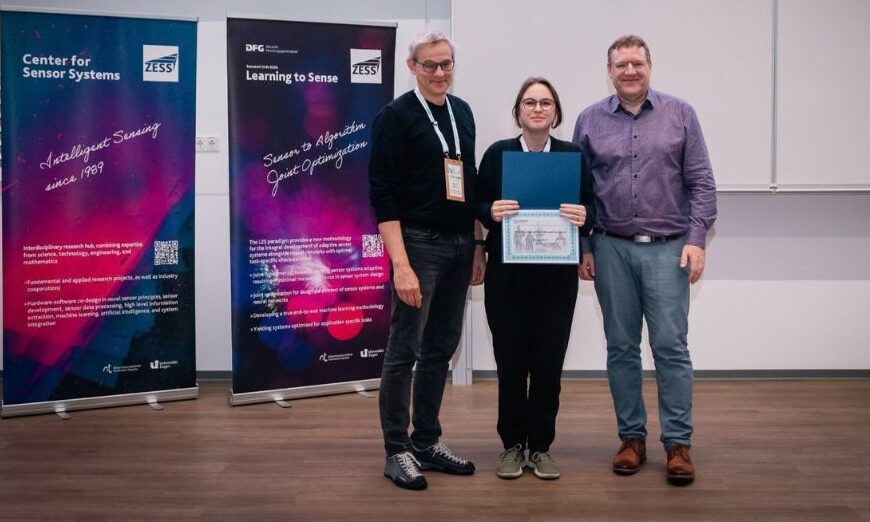
Prof. Dr. Zorah Lähner has received the German Pattern Recognition Award 2026. A professor at the University of Bonn and Principal Investigator at the Lamarr Institute, she combines the analysis of three-dimensional shapes with the development of geometrically grounded learning methods. Presented by the German Association for Pattern Recognition (DAGM), the early-career award recognizes outstanding, internationally visible research contributions in pattern recognition, computer vision, and machine learning.
Reliably Analyzing Deformable Surfaces
One focus of her research is establishing shape correspondences, meaning the identification of corresponding points on different 3D surfaces. For example, the aim is to identify the same location on a body in different scans, even when its pose has changed. Existing mathematical methods are sensitive to holes, measurement errors, or changes in surface structure. Lähner’s group investigates how such disturbances can be accounted for during optimization to make correspondences more robust under real-world scanning conditions.
Using Geometric Structures in Learning Models
Her work also extends beyond processing spatial data: Lähner investigates how the geometry of learned representations influences the behavior of learning algorithms and how mathematical constraints can be incorporated into neural networks. Her research thus aligns with hybrid machine learning at the Lamarr Institute, which combines data-driven methods with structured knowledge. Geometric properties can help guide model optimization and provide provable guarantees for certain properties of the results. In the project “AI for Fusion Engineering” with Proxima Fusion, for example, her research group develops AI tools for the geometric modeling and optimization of stellarator fusion devices.
Lähner previously received the Research Award of the University of Siegen’s Faculty of Science and Technology in 2023. The German Pattern Recognition Award supports researchers at an early stage of their careers whose scientific contributions demonstrably advance their respective fields.