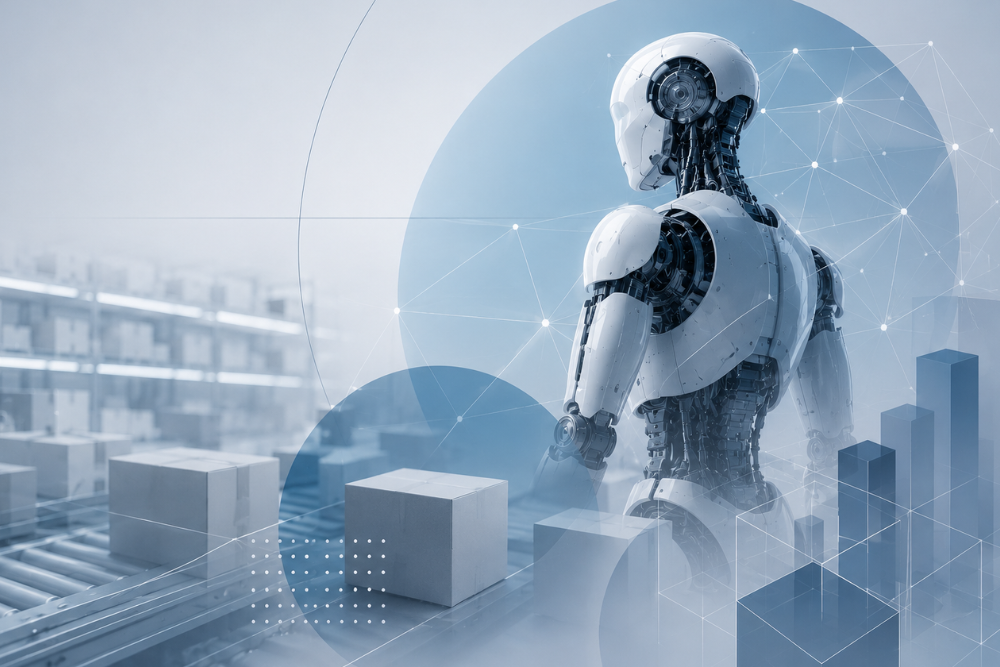
Humanoid robots are seen as a potential building block for future automation in logistics. A recent study by the Fraunhofer Institute for Material Flow and Logistics IML, a partner institute of the Lamarr Institute for Machine Learning and Artificial Intelligence, now examines the industry’s expectations for this technology, which application areas are considered particularly relevant, and what challenges still stand in the way of widespread practical use. The results also demonstrate how closely the further development of modern robotic systems is linked to advances in artificial intelligence.
Industry seeks flexible automation
The study focuses on the requirements of logistics environments, which are often characterized by changing tasks, diverse objects, and dynamic workflows. According to the study, companies see the greatest potential for humanoid robotics in activities such as order picking, sorting, and loading and unloading operations. What is needed are not necessarily human-like “all-rounders,” but rather flexible robotic systems that can be integrated into existing work environments and take on a variety of tasks. While pilot projects and initial trials demonstrate strong industry interest, respondents consider the technology to still be at an early stage of industrial deployment.
Technical maturity remains a key challenge
The study identifies the greatest current challenge as translating promising technological approaches into industrially robust applications. There is a particular need for development in the safe handling of a wide variety of objects, the robustness of systems in industrial operation, and their integration into existing process and IT environments. Safety requirements also play a central role, as future systems are expected to operate in direct collaboration with humans. The authors therefore view humanoid robotics less as a solution available in the short term and more as a long-term field of development that requires further technological advances.
AI forms the foundation of adaptive robotic systems
The findings also highlight the close connection between robotics and artificial intelligence. To navigate complex environments, recognize objects, make decisions, and adapt flexibly to new situations, robots rely on advanced methods in machine learning and perception.
These are precisely the kinds of challenges addressed by the Lamarr Institute. As one of Germany’s leading AI competence centers, it conducts research on high-performance, sustainable, trustworthy, and secure AI systems for applications in business and society. Research in machine learning, multimodal perception, and trustworthy AI provides an important foundation for robotic systems that are expected to operate reliably in dynamic environments.
Contextualizing a dynamic field of research
Humanoid robotics has been the subject of research and discussion for many years. However, thanks to advances in AI, sensor technology, and computing power, the field is currently gaining new momentum. The Fraunhofer IML study provides a current assessment of this field from the perspective of the logistics industry and highlights where concrete application prospects are emerging, what expectations exist, and what challenges still need to be addressed. In doing so, it contributes to a fact-based evaluation of a technology field whose further development is closely linked to advances in AI research.