What does it mean for an AI system to be socially intelligent?
As artificial intelligence increasingly moves beyond answering questions to interacting with people—as tutors, collaborators, healthcare assistants, mediators, companions, and scientific partners—a new research frontier is emerging: Social Artificial Intelligence. The challenge is no longer only to build AI systems that communicate fluently, but systems that can understand and navigate the social world responsibly, effectively, and safely.
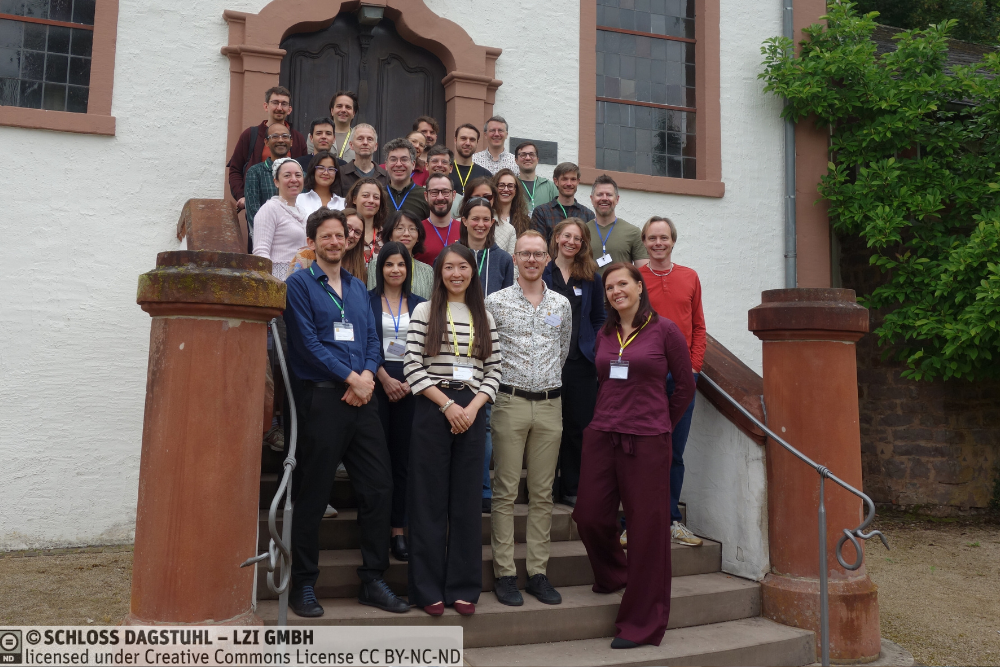
To address this challenge, Schloss Dagstuhl hosted the seminar “Social Intelligence in AI Systems,” bringing together leading researchers from artificial intelligence, natural language processing, cognitive science, psychology, human-computer interaction, philosophy, and computational social science to help define the scientific foundations of this rapidly growing field.
The seminar was organized by Prof. Lucie Flek (University of Bonn & Lamarr Institute), Prof. Jennifer Hu (Johns Hopkins University), Prof. Maarten Sap (Carnegie Mellon University), and Prof. Tomer Ullman (Harvard University). Together with an outstanding group of invited participants, they represented a uniquely interdisciplinary community spanning technical AI, behavioral sciences, cognitive science, linguistics, ethics, and human-computer interaction.
Participants included researchers from institutions such as Stanford University, Harvard University, Yale University, Carnegie Mellon University, New York University, the University of Michigan, King’s College London, the University of Waterloo, LMU Munich, the University of Bonn, the University of Tübingen, TU Delft, Ghent University, Bocconi University, VU Amsterdam, Charité Berlin, Google DeepMind, DFKI, and many others.
Unlike traditional conferences, Dagstuhl seminars are designed to build new research communities. By bringing together experts from different disciplines for an intensive week of discussion, they create an environment where fundamental questions can be examined collaboratively and long-term research agendas can emerge.
Throughout the week, participants explored a deceptively simple question:
What should social intelligence in AI actually mean?
While recent advances in Large Language Models have made AI systems appear increasingly socially capable, the seminar highlighted that fluent conversation should not be mistaken for genuine social reasoning. Understanding beliefs, intentions, goals, emotions, social norms, and cultural context—and knowing when and how to act upon that understanding—remains a fundamental scientific challenge.
One of the seminar’s central outcomes was the recognition that social intelligence is not a single capability but a multidimensional one, involving reasoning about other agents, adapting to context, maintaining coherent interactions over time, and supporting beneficial outcomes for people and society.
The discussions also identified a major gap in current AI evaluation. Existing benchmarks capture only part of social intelligence. Participants called for more situated, interactive, and longitudinal evaluation that measures human outcomes such as trust, learning, collaboration, autonomy, and wellbeing.
Beyond technical advances, the seminar underscored that Social Artificial Intelligence is inherently interdisciplinary. Questions such as what kinds of social behavior AI systems should exhibit, when they should resist rather than comply with users, and how increasingly social AI systems will shape society cannot be answered by machine learning alone.
“What I enjoyed most was seeing people from AI, psychology, cognitive science, and human-computer interaction learn from each other. We left with more agreement than I expected and a much clearer picture of the open questions and the road ahead.”
Prof. Lucie Flek, University of Bonn & Lamarr Institute
Rather than forcing consensus, the seminar identified productive scientific disagreements while converging on a shared research agenda for the emerging field of Social Artificial Intelligence.
The organizers and participants are now continuing this work through a Dagstuhl Report and a community position paper that will synthesize the seminar’s discussions and outline the major scientific challenges and future directions for the field.
As AI systems become increasingly integrated into education, healthcare, public services, scientific discovery, and everyday life, Social Artificial Intelligence is emerging as one of the defining interdisciplinary challenges of modern AI research.