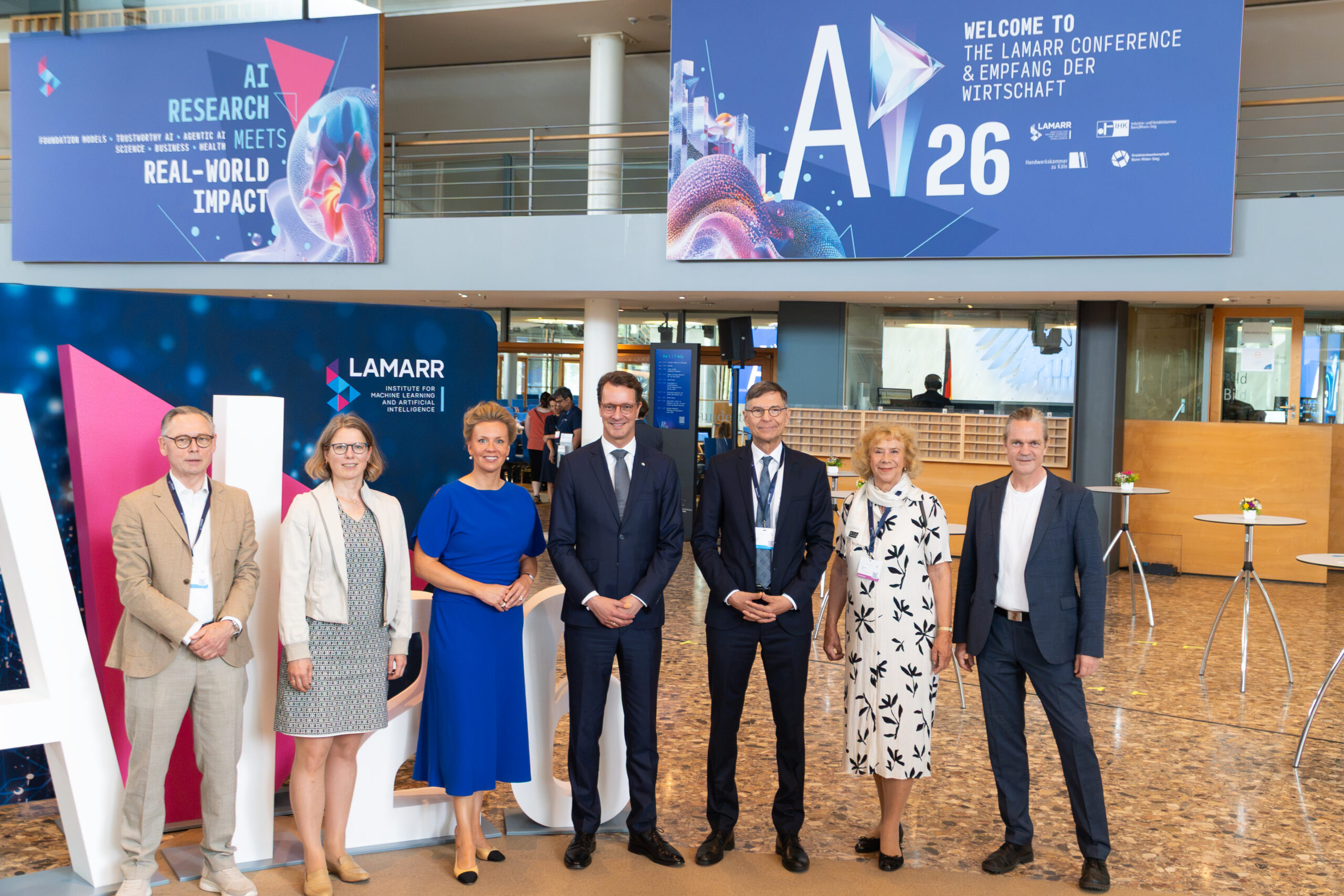
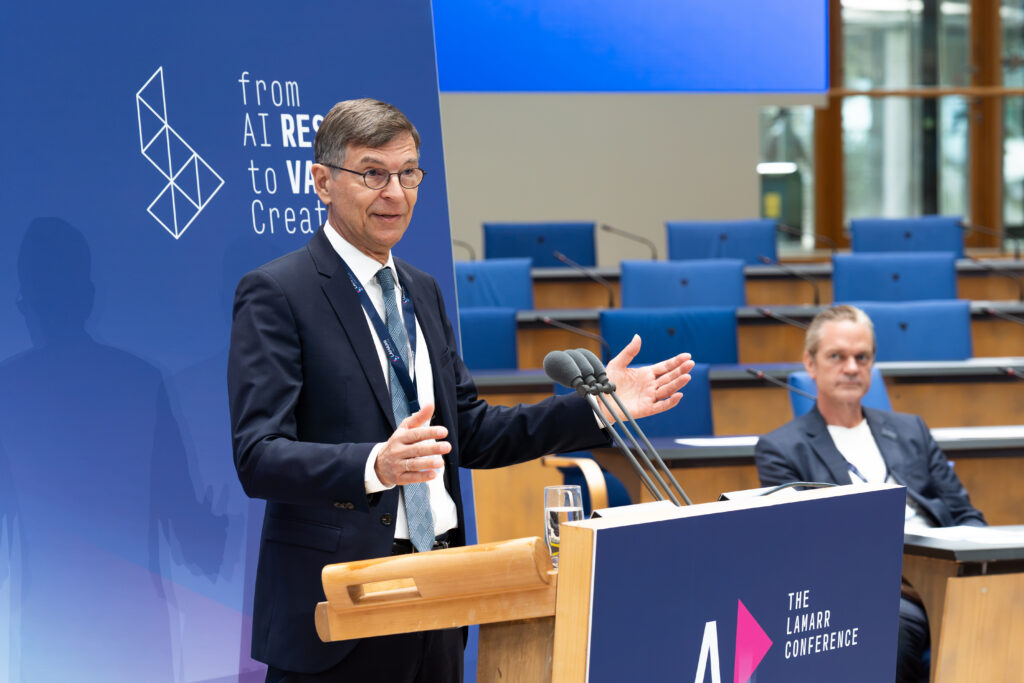
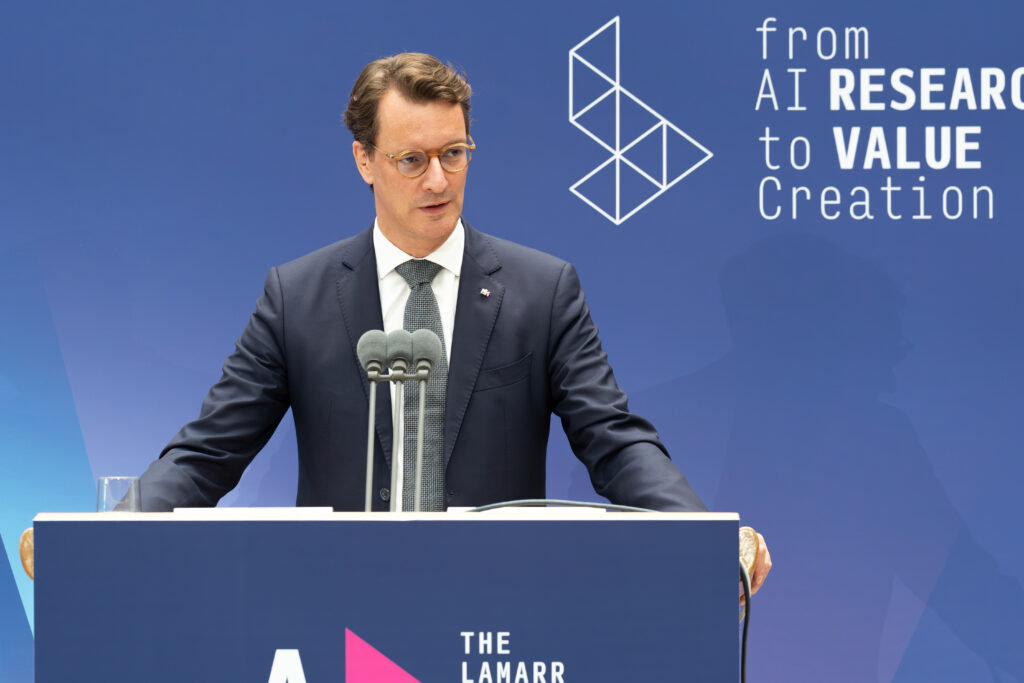
“North Rhine-Westphalia is moving from coal to AI. We have all the ingredients to become Germany’s leading AI hub: a strong industrial base and manufacturing sector, a vibrant SME landscape, and one of Europe’s most concentrated research and higher education ecosystems. North Rhine-Westphalia is where AI is developed from the initial idea to industrial application.” With these words, Hendrik Wüst, Member of the State Parliament and Minister-President of North Rhine-Westphalia, opened the AI26 – The Lamarr Conference today in the plenary hall of the former German Bundestag in Bonn. With its international conference on applied artificial intelligence, the Lamarr Institute for Machine Learning and Artificial Intelligence, in cooperation with the Bonn/Rhein-Sieg Chamber of Commerce and Industry, brings together around 400 leading experts from academia, business, and policy at the World Conference Center.
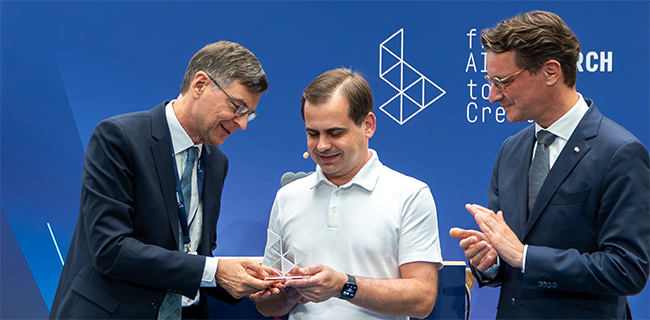
As part of the opening ceremony, Hendrik Wüst, Member of the State Parliament, presented this year’s Lamarr Award to Dr. Jarosław Kutyłowski, founder and CEO of the Cologne-based AI company DeepL. The Lamarr Award honors individuals who successfully translate scientific excellence into internationally competitive AI innovations: “Receiving the Lamarr Award is both an honor and a responsibility. It stands for the conviction that world-class research and real-world impact belong together — and that’s exactly the combination Europe needs to get right. We have the proof that Europe can build AI that global enterprises actively choose. The next chapter is about scaling that ambition, with the conviction that how we build matters as much as what we build.” For North Rhine-Westphalia, this combination of scientific excellence and successful industrial implementation is a central pillar of its AI strategy. As Minister-President Hendrik Wüst emphasized: “DeepL is an outstanding example of what is possible in North Rhine-Westphalia. Nowhere else are new technologies so closely connected to practical industrial application. North Rhine-Westphalia has become a magnet for the AI industry and its partners, and our transition from coal to AI is attracting international attention. The Lamarr Award for Dr. Jarosław Kutyłowski is richly deserved. His work provides important momentum for technological sovereignty and competitiveness. We are determined to make our state one of Europe’s leading AI hubs—and people like Jarosław Kutyłowski are helping to make that vision a reality.”
How Europe can successfully translate world-class AI research into innovation, competitiveness and societal impact is at the heart of AI26. Around 50 international experts from academia, industry and policy will explore these questions in an open dialogue with the audience. Among them are Oxford robotics researcher Prof. Dr. Ingmar Posner, medical AI expert Prof. Dr. Sylvain Baillet from CRCHUM Montréal, T-Systems CEO Dr. Ferri Abolhassan, DeepMind scientist Dr. Bogdan Georgiev, and Romina Medici, Global Data & AI Executive at the ERGO Group. AI26 focuses on interdisciplinary exchange: panels, expert sessions, and interactive formats bring researchers, industry representatives, and policymakers together in targeted discussions, creating space for ideas, new insights, and collaborative solutions.
From Cutting-Edge Research to Scaling and Competitiveness
Experts from various perspectives will discuss the conditions that must be met for scientific findings to quickly find their way into practice, and how we can reconcile values, value creation, and competitiveness.
“With AI centers of excellence such as the Lamarr Institute, Germany has very successfully strengthened world-class research in artificial intelligence. At the same time, universities, Fraunhofer Institutes, and industry partners are creating innovation hubs with a lasting impact on businesses and society. We want to further expand and accelerate this,” says Prof. Dr. Stefan Wrobel, co-director of the Lamarr Institute.
Another key topic is how Europe can establish AI as a scalable key technology within a strong ecosystem of research, industry and trusted infrastructure. “Europe’s strength lies not only in its AI research, but in its industrial ecosystem. Real AI value creation begins where AI models become value-generating applications in production, healthcare, public and defense. Therefore we don’t need the next large language model. We need industrial data, sovereign and trusted infrastructure, and the ability to scale innovation under European values. Just like we did with our AI factory in Munich – running our T Cloud on newest NVIDIA Technology,” Dr. Ferri Abolhassan, Board member Deutsche Telekom.
With Agentic AI systems the focus is increasingly shifting to the question of how companies can use artificial intelligence in the future not only to support individual tasks, but also to intelligently manage complex business processes. “The next wave of AI will not only produce more powerful models but also new forms of collaboration between humans and AI. Agentic systems can support and reorganize entire value-creation processes. The real competitive advantage arises when companies strategically leverage these opportunities and integrate them responsibly into their organizations,” says Romina Medici of the ERGO Group, describing the next stage of development for AI-supported business processes.
From Language Models to Systems That Act Intelligently
With Agentic AI, vision-language-action models, and new developments in robotics, Embodied AI marks the next step in the evolution of AI: from systems that process information to systems that perceive, learn from and interact with the physical world. International leaders in this field include Oxford robotics researcher Prof. Ingmar Posner, Dr. Bogdan Georgiev of Google DeepMind, and Prof. Dr. Maren Bennewitz of the University of Bonn and the Lamarr Institute. With embodied AI, AI is increasingly evolving from systems that process information to intelligently acting systems that can perceive their environment, learn from it, and act autonomously. “Through embodied AI, intelligent algorithms and robotics combine to form systems that can perceive their environment, learn autonomously, and act in the real world. This new generation of AI-powered robots will be able to support humans in complex real-world environments. At the same time, AI is revolutionizing science by helping researchers formulate scientific hypotheses and, for example, accelerating the discovery of new drugs and materials,” says Bennewitz.
AI Must Earn Its Place in the Healthcare System
Another key focus of AI26 is how artificial intelligence is making its way from research into clinical practice. The conference will center on current developments in patient-centered AI, AI-enabled diagnostics, and the integration of powerful AI systems into medical care processes. Whether AI will bring about lasting change in medicine depends on the concrete benefits it provides to patients, healthcare professionals, and healthcare systems. International collaboration is crucial for translating advances in AI research into improved clinical practice.
A new international partnership announced as part of AI26 demonstrates what such collaboration might look like: The Centre de recherche du Centre hospitalier de l’Université de Montréal (CRCHUM) and the Technical University of Dortmund—one of the Lamarr Institute’s core partners—will sign a joint memorandum of understanding at the conference. “I am enthusiastic about our partnership with the Lamarr Institute. Together, we aim to move beyond promising AI prototypes in biomedical research and healthcare, and to identify and responsibly deliver trustworthy solutions that can be scaled across our respective health systems. Our shared goal is to ensure that AI makes a positive difference where it matters most to patients: access, safety, equity, and sustainability,” explains Prof. Dr. Sylvain Baillet of CRCHUM Montréal.
Joining Forces for Europe’s AI Future
AI26 demonstrates that Europe will not succeed in the global AI race through new models or greater computing power alone. The key will be to combine scientific excellence with entrepreneurial implementation, trustworthy infrastructure and real-world applications. Today, the central challenges surrounding artificial intelligence can no longer be addressed by any single discipline or institution. “For the first time in history, a new technology is transforming every area of society simultaneously. That is why close collaboration between research, industry and policymakers is the key to scientific excellence, technological sovereignty, successful innovation and sustainable value creation,” says Ina Brandes, Minister for Culture and Science of the State of North Rhine-Westphalia. This very collaboration is essential to achieving the goals of Germany’s High-Tech Agenda and to translating scientific excellence into innovation, technological sovereignty, and sustainable value creation.