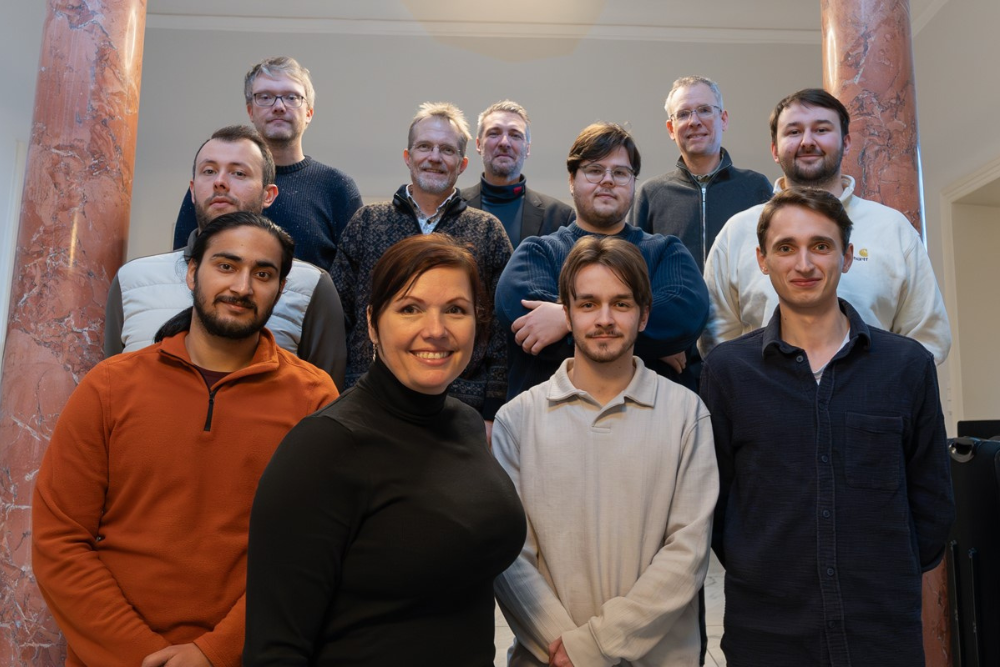
The research project AALearning (Adversarial and Uncertainty-Aware Learning) has officially started with its kick-off collaboration meeting this week. Funded by the German Federal Ministry of Research (BMFTR) within the ErUM-Data programme, AALearning aims to strengthen the robustness, interpretability, and reliability of machine-learning methods used in fundamental physics research.
AALearning brings together expertise from physics, machine learning, and AI safety. The project is jointly led by Prof. Dr. Matthias Schott (Rheinische Friedrich-Wilhelms-Universität Bonn), Prof. Dr. Lucie Flek, Area Chair for Natural Language Processing (NLP) at the Lamarr Institute and Professor at the University of Bonn and the Bonn-Aachen International Center for Information Technology (b-it), Prof. Dr. Alexander Schmidt (RWTH Aachen University), and Prof. Dr. Christopher Wiebusch (RWTH Aachen University). Associated partners include the industry partner scieneers GmbH and the research institute and Lamarr Partner Fraunhofer IAIS.
Safe and reliable AI for data-driven physics
Machine learning has become an indispensable tool in areas such as particle physics, astroparticle physics, and gravitational-wave research. At the same time, the increasing reliance on AI raises fundamental methodological challenges. Sensitivity to modeling assumptions, limited robustness to systematic uncertainties, and insufficient interpretability can directly affect the reliability and reproducibility of scientific analyses.
AALearning addresses these challenges by developing physics-conserving adversarial learning methods that explicitly incorporate physical laws, detector effects, and experimental uncertainties into the training process. In parallel, the project advances uncertainty-aware AI techniques, including simulation-based inference, to provide structured and interpretable uncertainty estimates that can be directly used in physics measurements.
A further focus of the project is the safety and reliability of generative AI models for fast simulation. While such models offer substantial computational advantages, AALearning systematically investigates under which conditions they can safely replace traditional, resource-intensive simulation techniques without compromising scientific validity.
From fundamental physics to trustworthy AI systems
Beyond its core applications in physics, AALearning also explores the transfer of its methodological insights to other AI domains. In particular, the project investigates how concepts such as epistemic and aleatoric uncertainty, robustness under adversarial perturbations, and safety-oriented evaluation—originally developed for physics analyses—can inform the assessment and mitigation of hallucinations in large language models.
By connecting uncertainty-aware learning in physics with challenges in modern AI systems, AALearning contributes to a broader understanding of trustworthy and reliable AI beyond a single application domain.
All methods, benchmarks, and software tools developed within the project will be released as open-source resources, strengthening the ErUM-Data community and contributing to international research efforts in transparent and trustworthy AI.
AALearning in the context of Lamarr’s research agenda
For the Lamarr Institute for Machine Learning and Artificial Intelligence, AALearning directly contributes to its core research agenda of developing high-performance, trustworthy, and resource-efficient AI methods. The project exemplifies Lamarr’s approach of embedding AI systems in their scientific context by tightly coupling methodological advances in machine learning with domain-specific knowledge from fundamental physics.
By focusing on robustness, interpretability, and uncertainty quantification, AALearning strengthens interdisciplinary collaboration between physics and AI research at Lamarr and advances methodological foundations that are relevant far beyond a single domain. The project’s explicit exploration of transfer concepts to large language models further aligns with Lamarr’s work on trustworthy AI and the responsible development of generative models.
Through its open-source orientation and close integration into the ErUM-Data framework, AALearning reinforces Lamarr’s role as a contributor to national and international research ecosystems at the interface of AI methodology and scientific application.
Building on established collaboration
AALearning builds on the successful ErUM-Data project AISafety (2023–2026), carried out by the same collaboration. The earlier project culminated in an open data challenge presented at ECML last year and laid important groundwork for the systematic study of robustness and uncertainty in physics-informed machine learning. With AALearning, this work is now being extended into a comprehensive research framework for safe and reliable AI in fundamental physics.