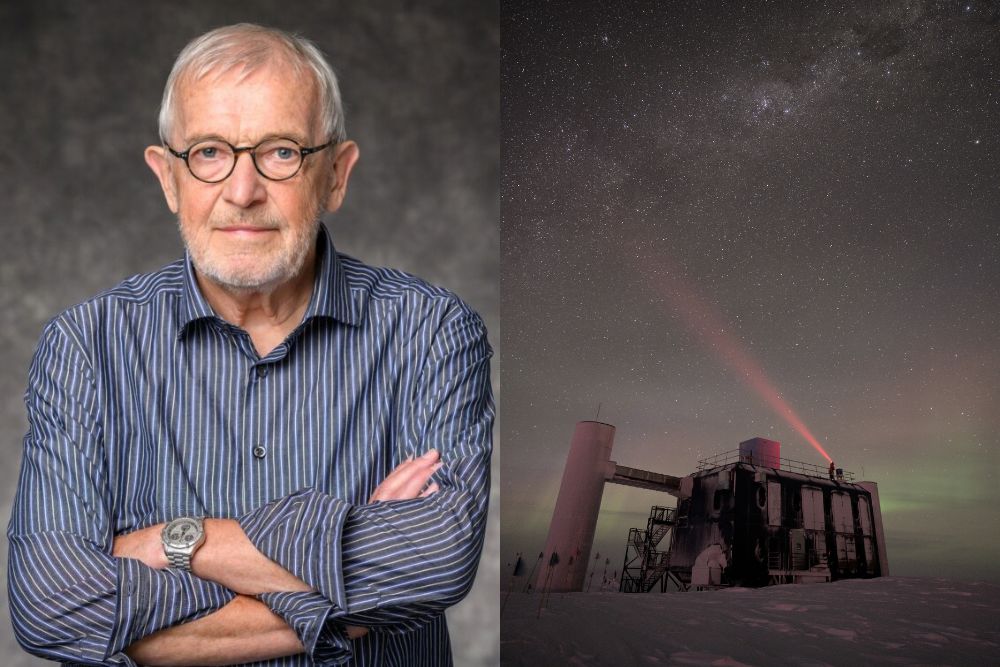
Francis Halzen receives the 2026 Nobel Prize in Physics for his decisive contributions to the IceCube Neutrino Observatory and the discovery of high-energy neutrinos of astrophysical origin. Prof. Dr. Halzen conducts research at the University of Wisconsin–Madison and is the Principal Investigator of the IceCube project. His work over several decades has opened up a new way of observing the universe. Speaking at today’s prize announcement, Francis Halzen says the most rewarding part of being awarded the 2026 Nobel Prize in Physics is recognising the people who have worked alongside him.
I hope this reflects on the really courageous people who joined me in the beginning of this project when no respectable conservative physicists would have joined me, but many talented people did, and that’s why I’m here.
The Lamarr Institute congratulates him on the recognition of this scientific pioneering achievement. Researchers affiliated with Lamarr at TU Dortmund University are members of the international IceCube Collaboration and contribute to its joint research programme through machine learning.
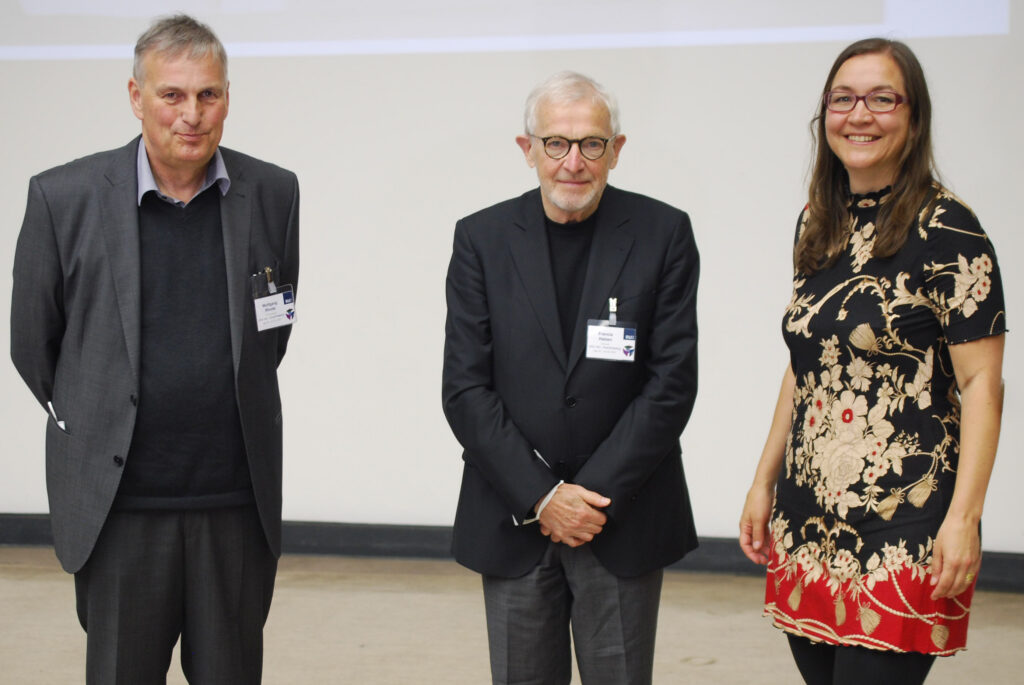
Halzen turned Antarctic ice into an astronomical instrument
A central question behind Halzen’s work has occupied physicists for more than a century: Where and how do the most energetic particles in cosmic rays originate? This radiation, consisting mainly of protons and other atomic nuclei, continuously reaches Earth. However, magnetic fields deflect these electrically charged particles along the way, making it difficult to determine their origin. Neutrinos are electrically neutral and maintain their direction of travel. They are produced, for example, when high-energy protons interact with matter, and can therefore provide clues about the cosmic accelerators that produce such protons.
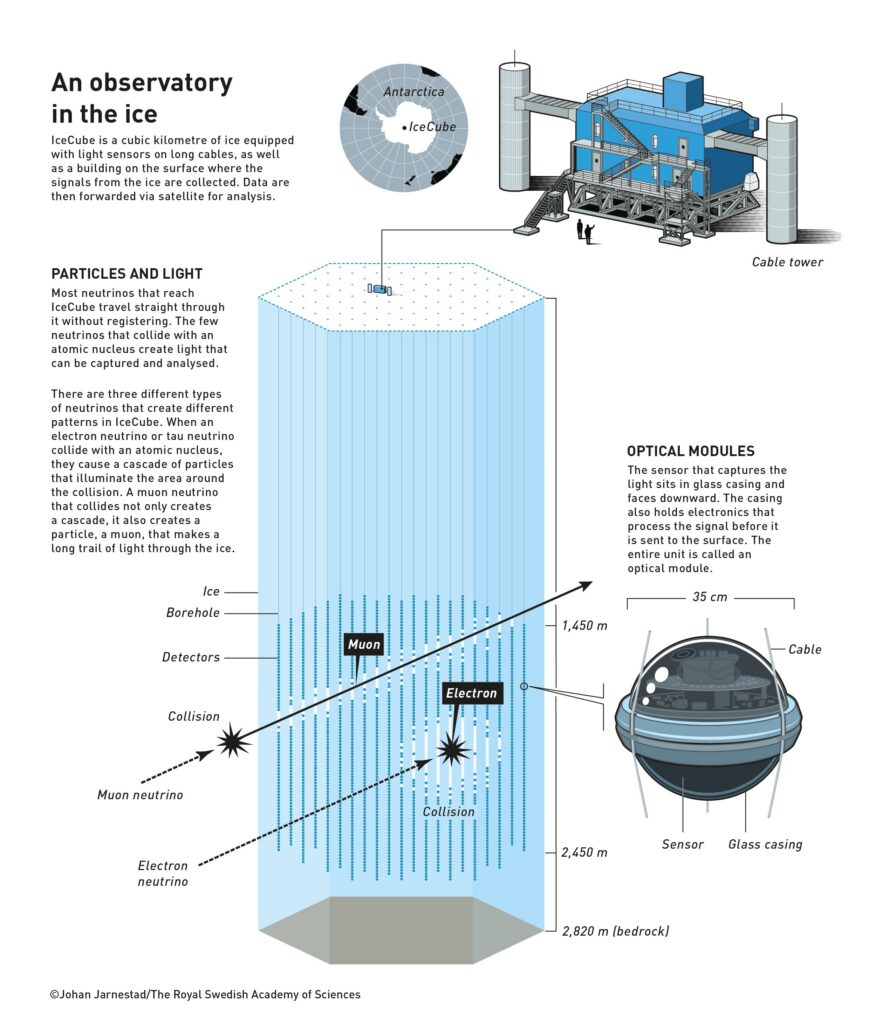
Because neutrinos interact with matter only extremely rarely, detecting them requires an enormous detection volume. For decades, Halzen drove the development of an observatory that uses deep Antarctic ice for this purpose. Working with an international team, the technical requirements were first tested in the predecessor experiment, AMANDA. Today, 5,160 optical sensors distributed throughout one cubic kilometre of ice capture the light signals from secondary particles produced in neutrino interactions. Halzen remains the project’s Principal Investigator and is part of its scientific leadership. The observatory also provides the foundation for the work of the international IceCube Collaboration, whose researchers jointly operate the detector, analyse data and investigate scientific questions.
In 2013, the collaboration published the first evidence for a flux of high-energy neutrinos of cosmic origin that could not be explained solely by processes in Earth’s atmosphere. This demonstrated that IceCube could indeed detect the sought-after particles from space. This breakthrough is a central reference point for the Nobel Prize recognition, which also encompasses Halzen’s decisive contributions to the observatory. His scientific vision and decades of collaborative development made a new astronomical observation channel experimentally accessible.
IceCube revealed the Milky Way’s signal through machine learning
Within this research programme, the IceCube Collaboration achieved the first detection of high-energy neutrino emission from the Milky Way in 2023. Machine learning methods developed by the Dortmund astroparticle physics group led by Prof. Dr. Wolfgang Rhode, Area Chair for Physics at the Lamarr Institute, made a decisive contribution. Mirco Hünnefeld developed new analysis methods within the group; this work was carried out in cooperation with the AI group of Lamarr Founding Director Prof. Dr. Katharina Morik within Collaborative Research Centre SFB 876. Convolutional neural networks, neural networks designed to recognise spatial patterns, together with decision trees, helped select suitable neutrino events and reconstruct their properties.
The study used so-called cascades, particle showers with an approximately spherical light pattern. Researchers at Drexel University developed methods for selecting these events; the Dortmund machine learning methods improved their identification and the determination of their energy and arrival direction. AI is changing the possibilities for data analysis in this field: Rare cosmic signals must be distinguished from the dominant atmospheric background within extensive measurement datasets. Faster and more precise reconstructions make it possible to retain substantially more suitable events for analysis. The IceCube Collaboration’s joint study included around 60,000 selected events from ten years of operation, approximately 30 times as many as an earlier cascade analysis. Together with other improvements, this made the search three times more sensitive.
The resulting “neutrino image” shows emission from the Galactic plane without resolving individual sources. It is consistent with neutrinos produced when cosmic rays interact with interstellar matter; sources that cannot yet be individually identified could also contribute. Which cosmic accelerators are responsible remains an open question. Contributions from researchers affiliated with Lamarr thus expand, within the IceCube Collaboration, the scientific capabilities of the observatory that Halzen played a pivotal role in establishing. They demonstrate how closely progress in neutrino astronomy is linked to the development of powerful analysis methods.
Further Reading: