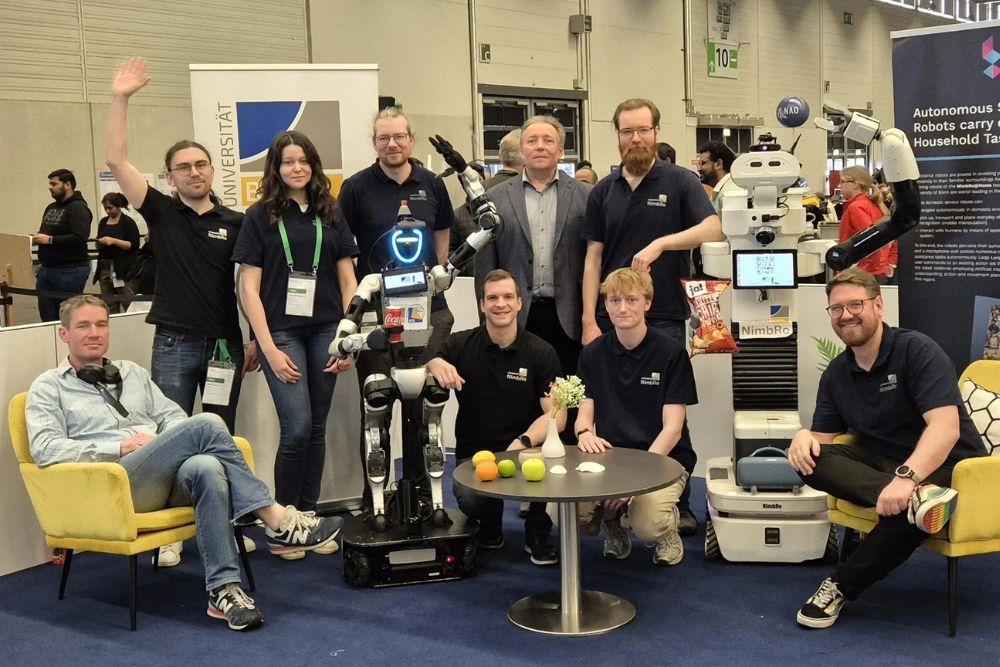
At the second German Robotics Conference (GRC), which brought together key players from academia, politics, and industry, the household robots from Bonn’s Team NimbRo@Home once again confidently defended their championship title at the RoboCup German Open—finishing well ahead of the competition. The competition took place in the @Home League, where assistance and AI-based multi-purpose robots demonstrate their capabilities in realistic everyday environments, particularly in supporting people in need of assistance in their daily lives. This success underscores the international excellence of robotics research at the University of Bonn and the Lamarr Institute for Machine Learning and Artificial Intelligence.
A commanding victory at RoboCup: NimbRo demonstrates the capabilities of modern assistive robotics
In a series of rigorous tests, the systems had to prove themselves in complex, real-world unfamiliar scenarios, including an apartment and a restaurant. The robots understood complex voice commands, navigated confidently through different environments, delivered orders, and performed tasks such as removing laundry from the washing machine.
This year, the competition tasks were significantly expanded and focused more closely on real-world application scenarios: The robots had to respond flexibly to new situations, combine various tasks, and, in particular, reliably translate natural-language instructions into concrete actions. In addition to an upgraded system, a new, lightweight assistive robot with two movable arms and tactile sensors was also deployed. The robot has a human-like upper body with two articulated arms that end in tactile grippers. It perceives its surroundings via cameras, laser scanners, and microphones and can move safely even in confined indoor spaces as well as reliably perform tasks requiring fine motor skills. Team NimbRo had already taken a clear lead in the preliminary round and further extended its lead in the final. It won the overall standings by a wide margin, successfully defending its title.
“The goal of our research is to enable people who need assistance to live independently in their familiar surroundings for longer,” says Prof. Dr. Sven Behnke, head of the Embodied AI research group at the Lamarr Institute and director of the Intelligent Systems and Robotics Institute at the University of Bonn.

Robotics for Social Inclusion: PRIVATAR in application
Prof. Dr. Maren Bennewitz presented presented a vivid example of application-oriented robotics research from the Lamarr research group at the German Robotics Conference. As a local organizer and moderator, she and her team presented the project “Privacy-Friendly Mobile Avatar for Sick Schoolchildren” (PRIVATAR). “We gave a robot demonstration of our PRIVATAR project, during which Minister Dorothee Bär was able to control our robot,” reports Bennewitz. The project develops user-friendly solutions to protect the privacy of affected groups—such as schoolchildren, teachers, and parents—when using mobile robots. The goal is to enable and scientifically evaluate data-efficient forms of robot-mediated participation by sick children in everyday school life.
The visit by the Federal Minister of Research also underscores the political relevance of such applications in the context of the high-tech agenda, in which AI and robotics are specifically promoted as key technologies. The general public will be able to experience PRIVATAR in May at the Bonn Science Night.
German Robotics Conference: How AI Is Transforming Robotics
Discussions at the German Robotics Conference (GRC) highlighted the current direction of robotics: Major advances in robotics are currently emerging primarily where perception, learning, and physical action interact within a single system: Robots must not only process data, but also make independent decisions in complex, unpredictable environments and execute them reliably. This shifts the focus from isolated AI functions to integrated, adaptive systems capable of handling real-world challenges—a core principle of embodied AI.
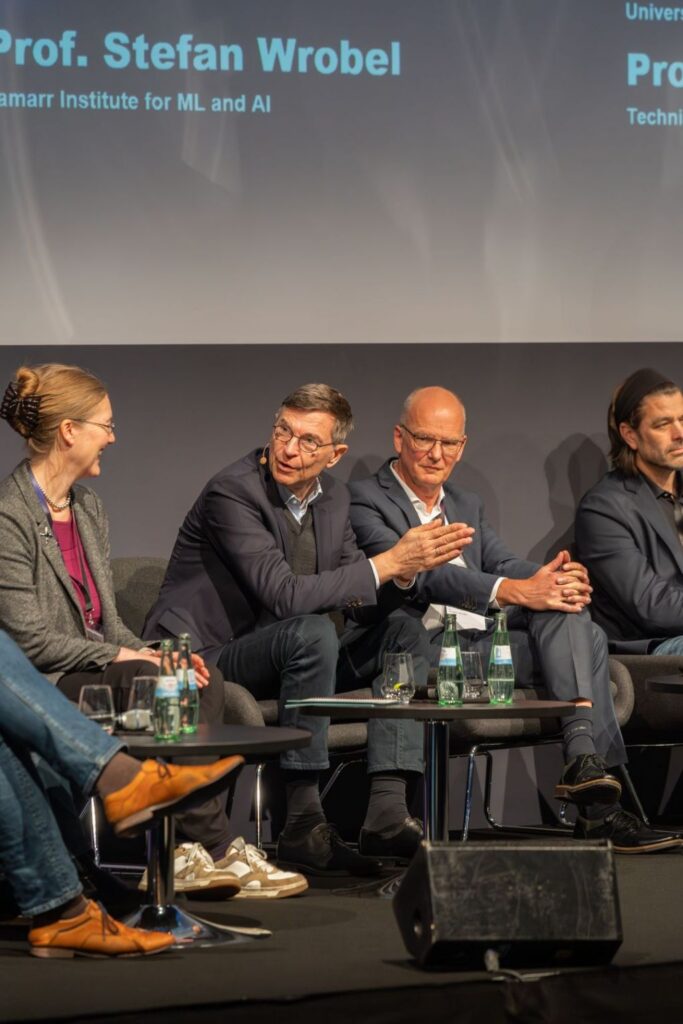
Lamarr Co-Director Prof. Dr. Stefan Wrobel emphasized the importance of interconnected AI ecosystems for this development during the panel discussion “AI Competence Centers & Networks.” This combination of technological excellence and structural collaboration is also reflected in policy initiatives: Artificial intelligence is considered a key technology, while robotics—for example, within the framework of the AI Robotics Booster of the High-Tech Agenda—is being specifically developed as a field of innovation. The recent successes and strong presence of the Lamarr community demonstrate just how closely basic research, competitive achievements, and practical applications are already intertwined—and the role they will play in the next generation of intelligent, everyday robotics.