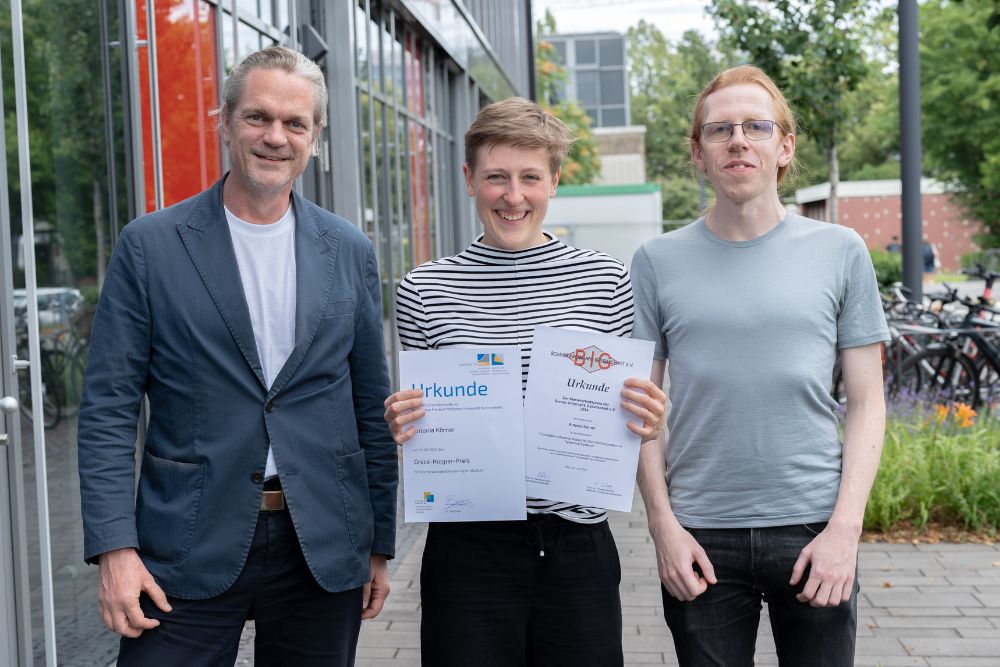
Former Lamarr student Antonia Körner receives the Grace Hopper Award from the Department of Computer Science at the University of Bonn for her excellent master’s thesis on AI-supported reconstruction of missing time series data. In addition, she was honored for her outstanding achievements with the Bonn Computer Science Society (Bonner Informatik Gesellschaft e.V. – BIG) Award, which is awarded annually for exceptional theses. Her thesis was written in close collaboration with the Lamarr Institute and is part of an international scientific publication.
Missing Values in Critical Systems – and a Convincing Solution
Time series data – for example from medicine, environmental protection or industry – form the basis of many data-based decisions. However, they are often incomplete: Measurement errors, technical failures or gaps in the recording make analysis difficult. Antonia Körner addressed this problem in her master’s thesis – and developed a model that automatically fills in missing values without ever having been trained on real-world data.
AI Model for Time Series Imputation – Zero-Shot Instead of Retraining
The core of her approach: a so-called foundation model that is trained exclusively on synthetically generated time series – i.e. on artificially generated data that comes as close as possible to real measured values. This strategy follows the zero-shot principle: the model is trained once and then transferred directly to real use cases without adapting the model to the specific application.
“I was fascinated by how versatile and robust a model can be – even if it has never seen real data,” she says, describing her motivation.
Körner is thus opening up a field in time series research that has hardly been addressed to date. Her model reliably handles a wide variety of inputs – whether regularly or irregularly distributed, with few or many data points, scalable across any number of dimensions. It also integrates a measure that estimates the uncertainty of the predictions – a key building block for trustworthy AI applications.
The results of their work show: The zero-shot approach can keep up with methods that have to be retrained for each data set with significantly less computational effort. The code developed by Körner is now considered the official reference implementation of the project and is part of the scientific publication “Zero-shot Imputation with Foundation Inference Models for Dynamical Systems” to which she is a co-author.
Collaboration with the Lamarr Institute
The work was carried out in close collaboration with the Lamarr Institute for Machine Learning and Artificial Intelligence, supervised by our scientists Dr. Ramsés J. Sánchez, Patrick Seifner and Dr. Kostadin Cvejoski.
“Antonia Körner combines deep mathematical understanding with excellent technical skills. She works reliably, communicates clearly and has quickly integrated into the team of authors,” said her supervisors. “Her results are a significant part of the publication – and a real contribution to research.”
Personal Development and Scientific Contribution
Körner herself looks back on the intensive time with gratitude. She particularly appreciates the balance of personal responsibility and teamwork: “I had a lot of freedom to try things out for myself, but at the same time I was able to have regular consultations. That gave me a lot both professionally and personally.”
Her personal development is also reflected in the Grace Hopper Award. After initial doubts during her mathematics studies, she found new self-confidence by working on real projects. “Since then, I see every project as a kind of mirror: it shows me what I have learned – and where I am at the moment.”
The Grace Hopper Award Honors Excellence and Courage
The Grace Hopper Award commemorates the US computer science pioneer of the same name, who was known for her courage to take unconventional paths – true to her motto: “If in doubt – do it.”
A motto that Antonia Körner also agrees with: “I am very proud that my commitment has been recognized. Perhaps it will motivate other students to also fully immerse themselves in a topic. You don’t have to know everything on your own – but you have to be ready to go.”
With her work, she proves that scientific excellence does not have to be loud to achieve great success. She shows what is possible when curiosity meets depth – and doubt meets the courage to try anyway.